
Mandatory AI Labeling for Companies
What Takes Effect in August 2026 and What You Must Label
The short answer
As of August 2, 2026, Section 50 of the AI Act requires transparency in the use of AI. Customers must be able to recognize that they are speaking with a chatbot. Companies must disclose deepfakes—that is, AI-generated images, videos, or audio clips that appear realistic. The same applies to AI-generated texts that provide information on topics of public interest without editorial review. Reviewed advertising and blog texts are generally not subject to this requirement.
Under Article 50 of the AI Regulation (EU) 2024/1689, also known as the AI Act, AI labeling has become mandatory for companies. According to Bitkom, 56 percent of companies that already use AI cite legal uncertainty as a barrier. This is particularly evident when it comes to the AI labeling requirement: Does every AI-generated image in a newsletter need a label? And what about text that has been pre-formulated by Copilot or ChatGPT?
This article explains what Article 50 of the AI Act requires, who is responsible for which obligations, and how you can implement the labeling requirements.
5 Key Takeaways
- The requirement has been in effect since August 2, 2026: The Digital Omnibus Act has not changed this.
- There is no general labeling requirement: It applies to chatbots, deepfakes, and certain AI-generated texts.
- Most companies are operators: Anyone using Copilot, ChatGPT, or Midjourney must disclose deepfakes in particular.
- Editorial review exempts AI-generated text: If a human reviews and takes responsibility for the text, the label is not required.
- Violations can be costly: Fines of up to 15 million euros or 3 percent of annual revenue are possible.
What does the AI labeling requirement under Article 50 of the AI Act cover?
Article 50 of the AI Act requires transparency in four cases. There is no general obligation to label all AI-generated content.
- Interaction with AI (para. 1): People must be able to recognize that they are speaking with an AI, such as a chatbot. Exception: This is already obvious.
- Machine-readable labeling (Paragraph 2): Providers of generative AI must technically label outputs, for example, using metadata or watermarks.
- Emotion recognition and biometric categorization (Par. 3): Affected individuals must be informed.
- Deepfakes and AI-generated text (Paragraph 4): Operators must disclose that content has been artificially generated or altered.
The notice must be clearly visible and accessible no later than the first point of contact (para. 5). The exact wording can be found in the text of Article 50 of the AI Regulation.
Who is responsible for labeling what: the supplier or the operator?
The AI Act distinguishes between two roles. Providers develop an AI system or bring it to market under their own name—such as OpenAI, Google, or Microsoft. Operators use an AI system in a professional capacity. Most small and medium-sized enterprises are operators.
| Contents | Responsibility | Responsible | Example |
|---|---|---|---|
| Chatbot or Voicebot | Note that an AI is responding | Provider; according to the Competition Center, this also includes anyone who integrates a purchased bot | “You are chatting with our AI assistant.” |
| Realistic AI images, videos, or audio (deepfakes) | Visible disclosure | Operator | A photorealistic team photo that was never taken |
| AI-generated text on topics of public interest without editorial review | Disclosure | Operator | Automatically published notices regarding changes to the law |
| All Applications of Generative AI | Machine-readable markup | AI tool provider | Metadata in an AI-generated image |
There is a transition period for machine-readable labeling: Providers of systems that were on the market before August 2, 2026, have until December 2, 2026, to comply. As an operator, check with your providers to find out how they are implementing this requirement.
Do AI-generated images and texts need to be labeled in marketing?
That depends on two questions: Does an image appear real? And does a text provide information on topics of public interest?
Images, videos, and audio: According to Article 3(60) of the AI Act, a deepfake is AI-generated content that resembles real people, objects, places, or events and would falsely appear to be real. In its July 2026 guidelines, the Competition Center interprets the concept of “resemblance” broadly. You should label a photorealistic model used in a swimwear campaign. A surreal scene—such as Big Ben wearing a hoodie—does not require a label, nor does simple noise reduction.
Texts: Advertising copy, product descriptions, and blog posts generally do not provide information on matters of public interest. For example, automatically published news items on politics or legislative changes are subject to labeling requirements. If a human reviews the text and a person or your company assumes editorial responsibility, this obligation does not apply.
Competition Law and Platforms: Regardless of the AI Act, the UWG prohibits misleading advertising. AI-generated testimonials that pretend to be from real customers may result in a cease-and-desist letter. Labels from Instagram or TikTok do not replace your own obligation. Our article on AI image generation in marketing explains how to use AI images safely.
Do you want your team to apply the labeling rules correctly?
What does proper AI labeling look like?
The labeling must be clear, unambiguous, and visible no later than the first point of contact. A notice in the legal notice alone is not sufficient.
- Image: Label directly on the image, for example, “AI-generated.”
- Video and audio: A on-screen label or voiceover at the beginning, repeated for longer formats.
- Chatbot: A notice in the first message, such as “You are chatting with our AI assistant.” According to the Wettbewerbszentrale, “AI-assisted” is not sufficient. Read more about this in the article on AI chatbots in customer service.
- Text: A clearly legible notice before the text, such as “This text was created using AI and has not been editorially reviewed.”
On June 10, 2026, the European Commission published a voluntary code of conduct on labeling and EU icons for AI content. Signatories can invoke the code’s provisions when dealing with the supervisory authority. By the end of July 2026, approximately 190 organizations had done so. For German-speaking audiences, the Wettbewerbszentrale recommends using “KI” instead of “AI.”
What should companies do now?
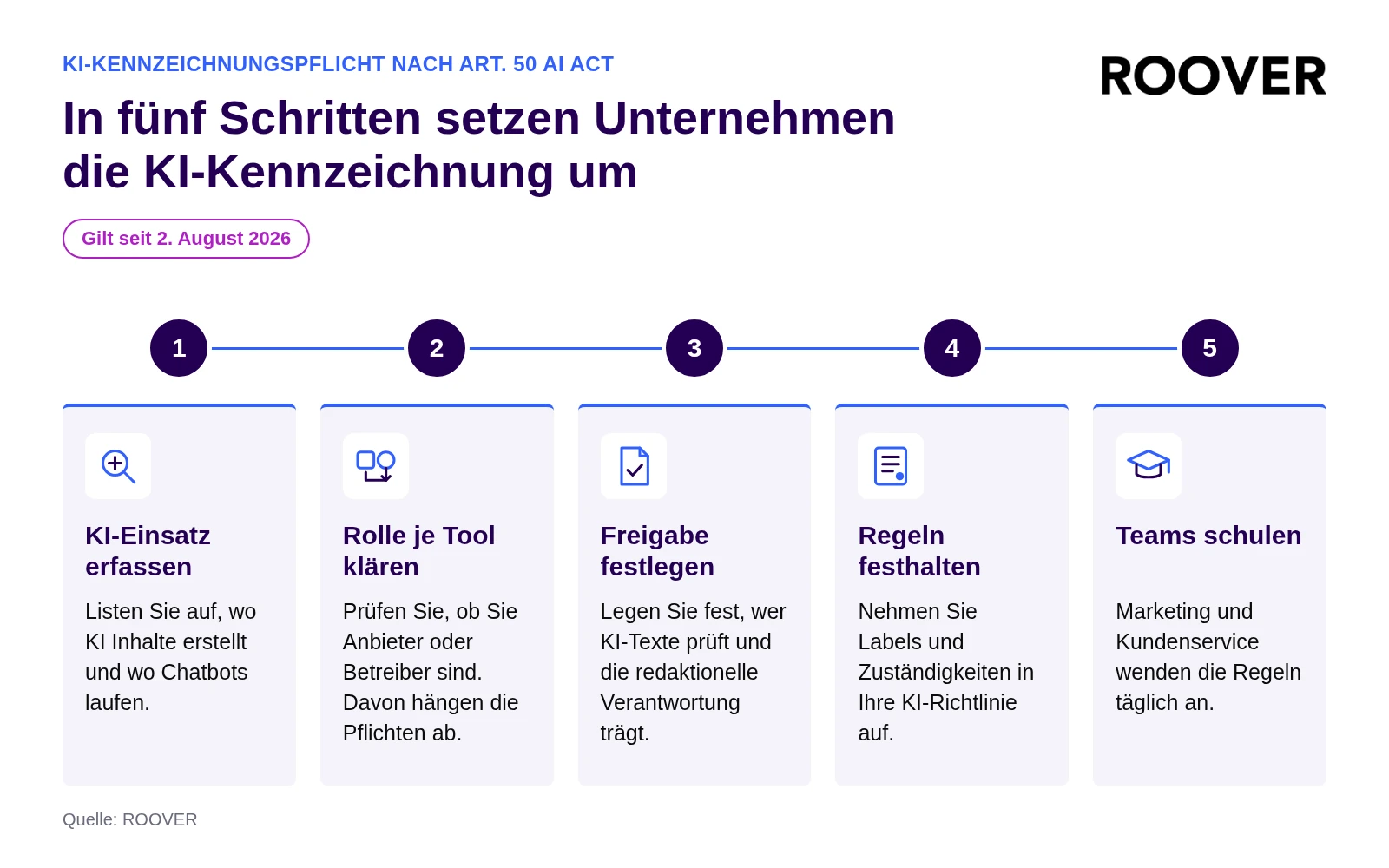
Follow these five steps to implement the AI labeling requirement in a structured way:
- Identify AI usage: List where AI generates content and where chatbots are in use.
- Clarify your role for each tool: Determine whether you are a provider or an operator. Anyone who offers an AI system under their own name is considered a provider.
- Define the approval process: Determine who reviews AI-generated text and bears editorial responsibility. Document the review process.
- Incorporate rules into the AI policy: Define labels and responsibilities. Our guide to corporate AI governance provides guidance.
- Train teams: Marketing and customer service apply the rules on a daily basis. Our article shows how to build AI expertise within your team.
Frequently Asked Questions About the AI Labeling Requirement
FAQ on AI Labeling
Yes. Article 50 does not specify a size threshold and applies to all commercial use. With regard to fines, the lower of the fixed amount and the percentage of revenue applies to SMEs (Article 99(6)).
No. Regulation (EU) 2026/1744 has been in effect since July 27, 2026. It postpones high-risk obligations until December 2027 and August 2028. Article 50 has been in effect since August 2, 2026. Only providers of existing systems have until December 2, 2026, to implement machine-readable labeling.
Not automatically. The responsibility remains with your company. The Competition Center recommends using your own label if the platform’s label is not clear enough.
Under the AI Market Surveillance and Innovation Promotion Act (KI-MIG), the Federal Network Agency is the competent market surveillance authority. State authorities remain responsible for media service providers. Violations are punishable by fines of up to 15 million euros or 3 percent of global annual revenue, whichever amount is higher (Art. 99, para. 4).
Questions about AI labeling?
Oliver Breucker answers your questions about AI labeling in your company.
Sources
- Regulation (EU) 2024/1689 (AI Regulation), EUR-Lex
- Art. 50 AI Regulation, German text
- European Commission: Guidelines on Transparency Requirements under Art. 50 (July 2026)
- European Commission: Code of Practice on Transparency of AI-Generated Content (June 2026)
- Competition Authority: Guide to Labeling AI-Generated Content (July 2026)
- Steptoe: EU AI Act Amendments Enter into Force (July 2026)
- Bitkom: For the First Time, a Majority of Companies Are Using AI (September 2026)
Researched with AI support, editorially reviewed by Oliver Breucker.
As of October 13, 2026. This article provides an overview and is not a substitute for legal advice.
About the Author
Oliver Breucker
Managing Director ROOVER
Oliver Breucker ist Experte für KI-Transformation bei Roover und ehemaliger Strategieberater von Roland Berger. Mit Expertise vom MIT unterstützt er Unternehmen bei KI-Strategien und digitalem Erfolg.
You might also be interested in
Many companies have launched their first AI pilots. Copilot is being tested, teams are experimenting with prompts and different AI tools. At the same time, it often remains unclear how these individual activities can be turned into a structured system of AI training, AI training courses, workshops and longer course
Chatbots are now everywhere: on websites, in customer portals, in apps. Almost all of us have seen a small chat window asking: “How can I help you?” Nevertheless, many companies still have an uneasy feeling. Is this really good customer service or just another digital filter in front of the